Data Center Colocation: The Complete Guide to Choosing the Right Partner
At some point, every growing infrastructure outgrows a server closet — or outgrows the limits of pure cloud spend. That’s usually when colocation enters the conversation. This guide covers what colocation actually means, why companies choose it over cloud-only or on-premise setups, and the concrete checklist to run through before you sign a contract.
What is colocation, and how is it different from cloud hosting?
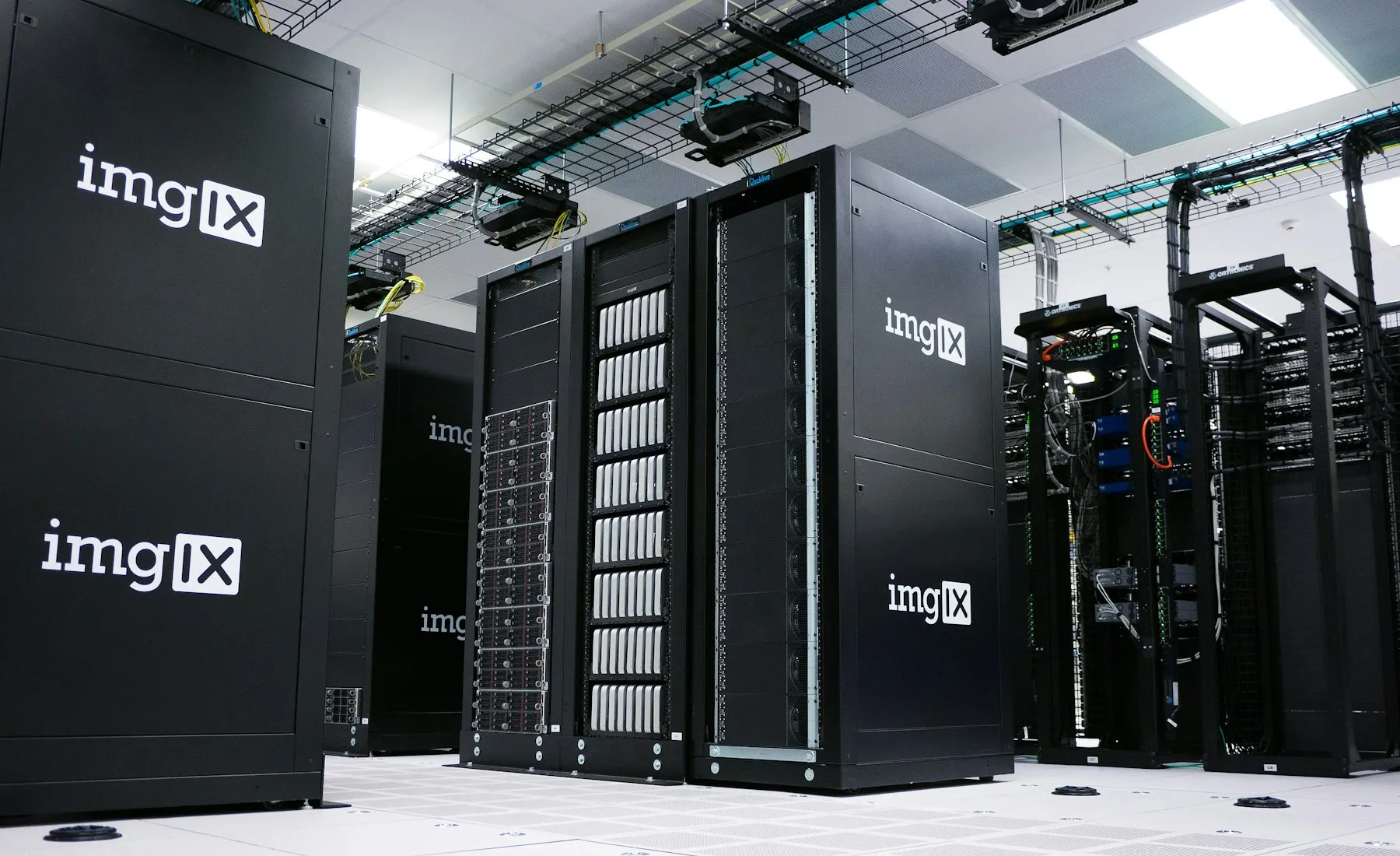
Colocation means renting physical space — a rack unit, a full rack, or a private cage — inside a professionally-operated data center, where you install and own your own servers and networking equipment. The data center provides the building: power, cooling, physical security, and connectivity. You provide (and fully control) the hardware.
This sits between two other models: fully on-premise hosting, where you own the building too, and public cloud, where you don’t own any hardware at all and rent compute by the hour. Colocation gives you the control and cost-predictability of owning your hardware, without the capital expense and operational burden of running the physical facility yourself.
Key benefits of colocation
- Cost predictability. A rack and a power draw come at a fixed, known monthly cost — unlike cloud compute, where usage-based billing can spike unpredictably with traffic or workload changes.
- Full hardware control. You choose the exact CPU, storage, and networking gear your workload needs, instead of working within a cloud provider’s instance catalog.
- Connectivity density. A good colocation facility is a meeting point for multiple carriers, IP transit providers, and internet exchange points — connectivity options a private server room simply can’t offer.
- Compliance and data sovereignty. For regulated workloads or data that must stay within a specific jurisdiction, colocation in a facility physically located in that jurisdiction is often simpler to demonstrate than a cloud provider’s regional guarantees.
- Disaster recovery. Colocating a secondary environment in a separate facility from your primary infrastructure is a standard, cost-effective way to build real redundancy.
What to look for in a data center partner
Not all data centers are built — or operated — to the same standard. Before committing, evaluate:
- Uptime track record and SLA — ask for the facility’s actual historical uptime, not just a marketing claim, and check what the SLA credits for downtime actually look like.
- Power redundancy — N+1 at minimum, ideally 2N for critical workloads, with UPS and generator backup that’s actually tested on a schedule, not just installed.
- Physical security — biometric access control, 24/7 on-site staff, camera coverage, and visitor logging.
- Carrier neutrality — a facility that hosts multiple network operators gives you real negotiating leverage and redundancy options; a single-carrier facility locks you into whatever that one provider charges.
- Remote hands availability — when you can’t be physically present, you need a facility that can rack a drive, power-cycle a server, or run a cable on your behalf, promptly and reliably.
- Connectivity options on-site — IP transit, peering, dark fiber, and Layer 2 interconnect to other facilities, all available without a third-party cross-connect broker in the middle.
Owned vs. neutral data centers
Colocation providers generally fall into two models: owned facilities, where the provider operates the building itself end-to-end, and neutral facilities, where the provider colocates its own equipment inside a third-party, carrier-neutral data center it doesn’t own.
Owned facilities typically give you tighter integration between your connectivity provider and the physical infrastructure, and often better pricing since there’s no intermediary. Neutral facilities can offer access to specific markets or interconnection ecosystems that would otherwise require building an entirely new relationship with a different data center operator. Fiberway operates both models through FiberCenters™ — its own facilities, and colocation within major neutral data centers — so the choice comes down to which market and connectivity mix your workload actually needs.
Data sovereignty and compliance in France and Europe
For companies handling regulated or sensitive data, where that data physically resides is increasingly a compliance question, not just a technical one. GDPR already sets the baseline for personal data handled within the EU, and sector-specific frameworks — particularly around public sector and critical infrastructure workloads in France — add further requirements around where infrastructure is hosted and who can access it. Colocating in a French or EU-based facility, with a provider who can clearly document physical location, access controls, and data handling practices, is generally the most straightforward path to satisfying these requirements without renegotiating your entire architecture.
How much does colocation actually cost?
Colocation pricing usually breaks down into a few components:
- Space — priced per rack unit (U) for small deployments, or per full rack/cage for larger ones.
- Power — billed either as a flat allocation (e.g., a fixed number of amps or kW) or metered on actual draw.
- Cross-connects — the fee to physically connect your rack to another tenant, carrier, or the facility’s own connectivity services.
- Bandwidth — if you’re buying IP transit or internet access through the facility rather than bringing your own carrier.
- Remote hands — often billed hourly for anything beyond basic reboot/power-cycle requests.
The line items that catch people off guard are almost always cross-connect fees and metered power overages — both worth clarifying explicitly before signing, not after your first invoice.
Colocation checklist before you sign
- Confirm actual historical uptime and what the SLA credits for a breach look like.
- Verify power redundancy (N+1 minimum) and ask when backup power was last tested.
- Check which carriers, IXPs, and transit providers are already present on-site.
- Ask whether cross-connects, metered power, and remote hands are separately billed — and get real numbers, not ranges.
- Confirm physical location satisfies any data residency or compliance requirement you’re subject to.
- Ask about expansion capacity — can you add racks or power in the same facility as you grow, or will you need to migrate?
Frequently asked questions
Is colocation cheaper than the cloud? For steady, predictable workloads with hardware you already own or plan to own long-term, colocation is usually cheaper over a multi-year horizon than equivalent cloud compute. For highly variable or short-lived workloads, cloud’s pay-as-you-go model often wins.
Can I combine colocation with cloud services? Yes — this is one of the most common architectures today. Colocated infrastructure typically handles predictable, steady-state workloads (databases, core application servers), while cloud handles bursty or elastic capacity, connected via a direct low-latency link between the two environments.
What’s the difference between a rack unit, a rack, and a cage? A rack unit (U) is a small slice of a shared rack, suitable for a single server or a small deployment. A full rack gives you dedicated, exclusive space. A cage is a physically walled-off, lockable area for deployments large enough to need dedicated floor space and additional physical security.
Do I need my own IP transit if I colocate? Not necessarily — most colocation providers, including Fiberway, offer IP transit and DDoS protection directly on-site, so you can source connectivity, protection, and physical hosting from a single provider instead of coordinating between separate contracts.
Find the right colocation footprint for your infrastructure
Fiberway operates FiberCenters™ across multiple strategic locations in France and Europe, with IP transit, peering, and anti-DDoS protection available on-site. Talk to a Fiberway engineer about the right footprint for your infrastructure.
Need help with this?
Talk to a Fiberway network engineer about your FiberCenters needs — no obligation, no generic sales pitch.